
If you have ever opened a crochet pattern and felt like you were reading a secret code, you are not alone. Lines like “Rnd 3: *Sc in next st, inc in next st; rep from * around. (18 sts)” can look intimidating at first. The good news? Crochet patterns follow a fairly consistent shorthand, and once you learn a handful of abbreviations and symbols, most beginner patterns become surprisingly easy to follow.
This guide walks you through everything you need to read a beginner crochet pattern written in US terms: the most common abbreviations, how rows and rounds work, what all those asterisks and parentheses mean, and the mistakes that trip up most new crocheters.
US vs. UK Crochet Terms: Why It Matters
Before anything else, check which terminology your pattern uses. US and UK crochet patterns use some of the same stitch names for different stitches, which is one of the most common sources of beginner confusion.
| US term | UK term |
|---|---|
| single crochet (sc) | double crochet (dc) |
| half double crochet (hdc) | half treble crochet (htr) |
| double crochet (dc) | treble crochet (tr) |
| treble crochet (tr) | double treble crochet (dtr) |
| skip | miss |
Notice that “double crochet” means a different stitch depending on where the pattern was written. If a pattern doesn’t say which terms it uses, look for clues: US patterns typically include “sc” (UK patterns don’t use the term “single crochet”), and UK patterns often use “htr” or “miss.” All tutorials on Zuneloria use US terms.
Common Crochet Abbreviations
Here are the abbreviations you will see most often in beginner patterns:
- ch – chain. The foundation of most projects: yarn over and pull through the loop on your hook.
- sl st – slip stitch. Insert the hook, yarn over and pull through both the stitch and the loop on your hook. Often used to join rounds or move across stitches without adding height.
- sc – single crochet. Insert the hook, yarn over, pull up a loop (2 loops on hook), yarn over and pull through both loops.
- hdc – half double crochet. Yarn over, insert the hook, yarn over and pull up a loop (3 loops on hook), yarn over and pull through all 3 loops.
- dc – double crochet. Yarn over, insert the hook, yarn over and pull up a loop (3 loops on hook), [yarn over and pull through 2 loops] twice.
- st(s) – stitch(es). A general word for any stitch, used when counting or when the instruction applies to whatever stitch comes next.
- inc – increase. Work 2 stitches into the same stitch, adding one stitch to your count. In many patterns “inc” means 2 sc in the same stitch, but always check the pattern’s notes.
- dec – decrease. Combine two stitches into one, reducing your count by one. A single crochet decrease (often written sc2tog) means: insert into the next stitch and pull up a loop, insert into the following stitch and pull up a loop (3 loops on hook), then yarn over and pull through all 3.
You will also see small helper words such as rep (repeat), sk (skip), yo (yarn over), RS/WS (right side/wrong side), beg (beginning) and tog (together). Most patterns include an abbreviation key near the top; read it before you start, because designers sometimes define a term in their own way.
Rows vs. Rounds
Patterns are usually worked in either rows or rounds, and each line of instructions tells you which.
Working in rows
Row instructions (written “Row 1,” “Row 2,” and so on) are worked back and forth. At the end of each row you turn your work and begin the next row, usually with a turning chain. The height of the turning chain matches the stitch: typically ch 1 for sc, ch 2 for hdc, and ch 3 for dc.
Whether the turning chain counts as a stitch varies. For single crochet, the ch 1 usually does not count. For double crochet, the ch 3 often does count as the first stitch. A good pattern tells you, for example: “Ch 1 (does not count as a st).” If it doesn’t, check the stitch count at the end of the row to figure it out.
Working in rounds
Round instructions (written “Rnd 1,” “Rnd 2,” etc.) are worked in a circle, starting from a center ring such as a magic ring or a short chain joined with a slip stitch. Rounds are common in amigurumi, hats, coasters and granny squares.
There are two main ways to work rounds:
- Joined rounds: you finish each round with a sl st into the first stitch, then chain up to start the next round.
- Continuous (spiral) rounds: you keep crocheting without joining. This is very common in amigurumi. Because it’s easy to lose your place, use a stitch marker in the first stitch of each round.
Asterisks, Parentheses and Brackets
Symbols are where many beginners get stuck, but each one has a clear job.
Asterisks ( * ) mark the start of a repeated section. “*Sc in next st, inc in next st; rep from * around” means: work “sc in next st, inc in next st,” then keep repeating that same sequence until you reach the end of the round.
Parentheses ( ) and brackets [ ] are used in a few ways, so read them in context:
- A group of stitches worked in the same place: “(sc, ch 1, sc) in next st” means all three are worked into one stitch.
- A sequence to repeat a set number of times: “[sc in next st, ch 1] 3 times” means work that bracketed sequence three times in a row.
- Stitch counts: a number in parentheses at the end of a line, such as “(18 sts),” tells you how many stitches you should have after completing that row or round.
Designers vary in how they use these symbols, so check the pattern notes if something looks ambiguous.
Sample Pattern Notation (and How to Read It)
Here is a short, generic example of how instructions are written. It’s for practice reading only, not a full project.
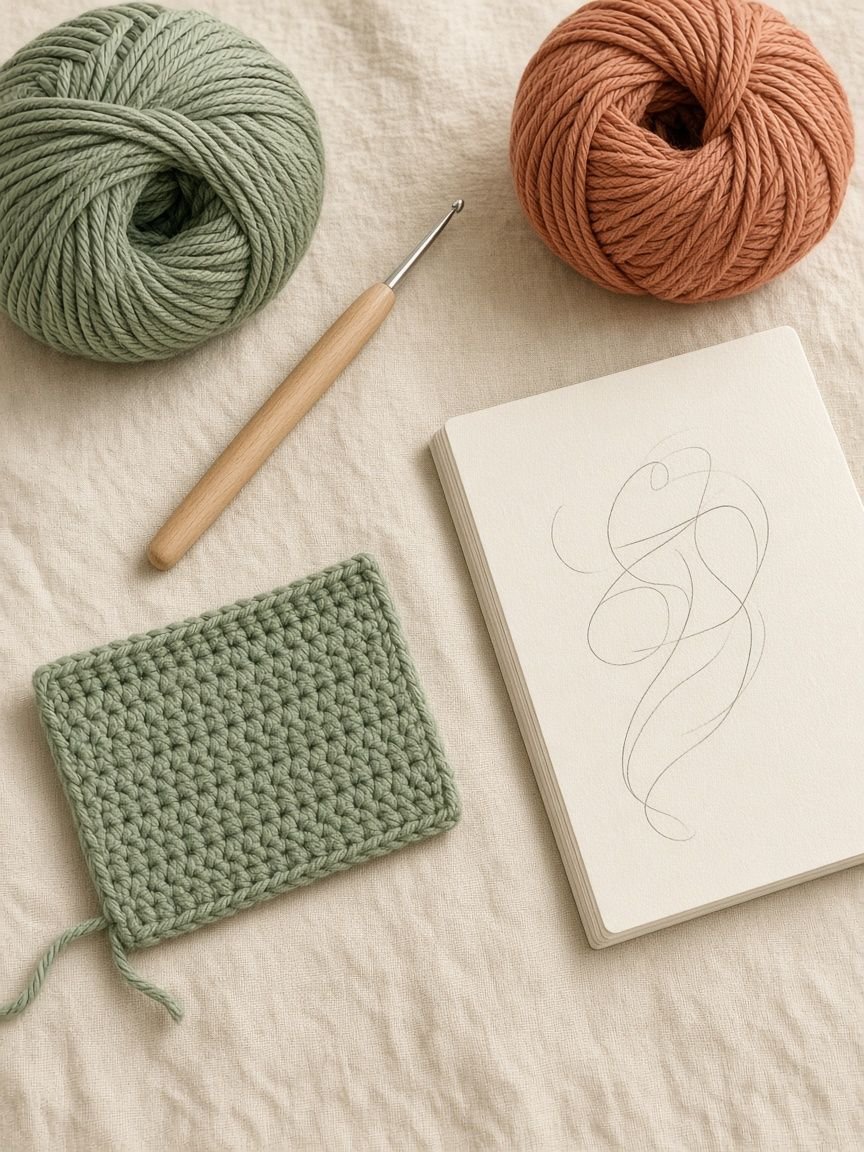
Rows example: a small single crochet swatch
Ch 11.
Row 1: Sc in 2nd ch from hook and in each ch across, turn. (10 sc)
Row 2: Ch 1 (does not count as a st), sc in each st across, turn. (10 sc)
Rows 3–8: Rep Row 2.
Fasten off.
How to read it: You chain 11. In Row 1, you skip the first chain next to your hook. That skipped chain acts as the turning chain: it brings the yarn up to the height of a single crochet and does not count as a stitch. You then work one single crochet in each of the remaining 10 chains, giving 10 stitches. In Row 2, you chain 1, which doesn’t count as a stitch, then work 10 single crochet. Rows 3 to 8 repeat Row 2 exactly.
Rounds example: the start of a flat or amigurumi circle
Rnd 1: Make a magic ring, 6 sc in ring. (6 sts)
Rnd 2: Inc in each st around. (12 sts)
Rnd 3: *Sc in next st, inc in next st; rep from * around. (18 sts)
How to read it: Round 1 gives 6 stitches. In Round 2, every stitch gets an increase (2 sc), which doubles the count to 12. In Round 3, the sequence “1 sc, then 1 increase” repeats 6 times, giving 6 × 3 = 18 stitches.
Common Beginner Mistakes (and How to Avoid Them)
- Mixing up US and UK terms. Confirm the terminology before you start, especially if you found the pattern online.
- Skipping the notes and gauge sections. Notes explain special stitches and whether turning chains count. Gauge (stitches and rows per measured area) affects the finished size, which matters for wearables.
- Working into the turning chain by mistake. If your rows grow or shrink, check whether you’re accidentally working into (or skipping) the turning chain.
- Losing track of the first stitch in a round. Use a stitch marker and move it up every round.
- Not counting stitches. Check your count against the number in parentheses at the end of each row or round.
- Reading too far ahead. Read one line at a time and break it into small chunks at each comma.
Practical Tips for Reading Patterns
- Read the whole pattern once before you begin.
- Print the pattern or copy it into notes, then mark off each row or round as you finish it.
- Practice on a small swatch first, in a smooth, light-colored worsted-weight yarn that makes stitches easy to see.
FAQ
What does “2nd ch from hook” mean?
Count the chains starting from the hook, but don’t count the loop that is on your hook. The first chain next to the loop is the 1st; the one after it is the 2nd.
Does the turning chain count as a stitch?
It depends on the pattern. For single crochet it usually doesn’t; for double crochet, a ch 3 often does. The pattern should say so; if not, use the stitch count to check.
What is the difference between “inc” and “dec”?
An increase works two stitches into one stitch (adding one); a decrease joins two stitches into one (removing one).
What does “rep from * around” mean?
Repeat the instructions that come after the asterisk until you reach the end of the round.
How do I know if a pattern uses US or UK terms?
Many patterns state it near the top. If not, look for “sc” (US only) or “htr” and “miss” (UK).
Are crochet charts the same as written patterns?
Charts show the same instructions with standard symbols instead of words. Many patterns include both; this guide focuses on written instructions.
Keep Learning
Reading patterns gets easier every time you do it. Start with a simple swatch, count your stitches, and take it one line at a time. For more beginner-friendly guidance, explore our Crochet for Beginners section, and when you’re ready to practice, browse our Free Crochet Patterns page.
Happy crocheting!